Last updated: July 2026
Suggested URL slug: what-is-forward-deployed-engineer-role-skills-salary-career-path
Meta description: Learn what a Forward Deployed Engineer does, why the role is booming in the AI era, required skills, salary ranges, career path, interview preparation, and how it compares with software engineers, solutions engineers, consultants, and SREs.
1. Introduction: Why Everyone Is Suddenly Talking About Forward Deployed Engineers
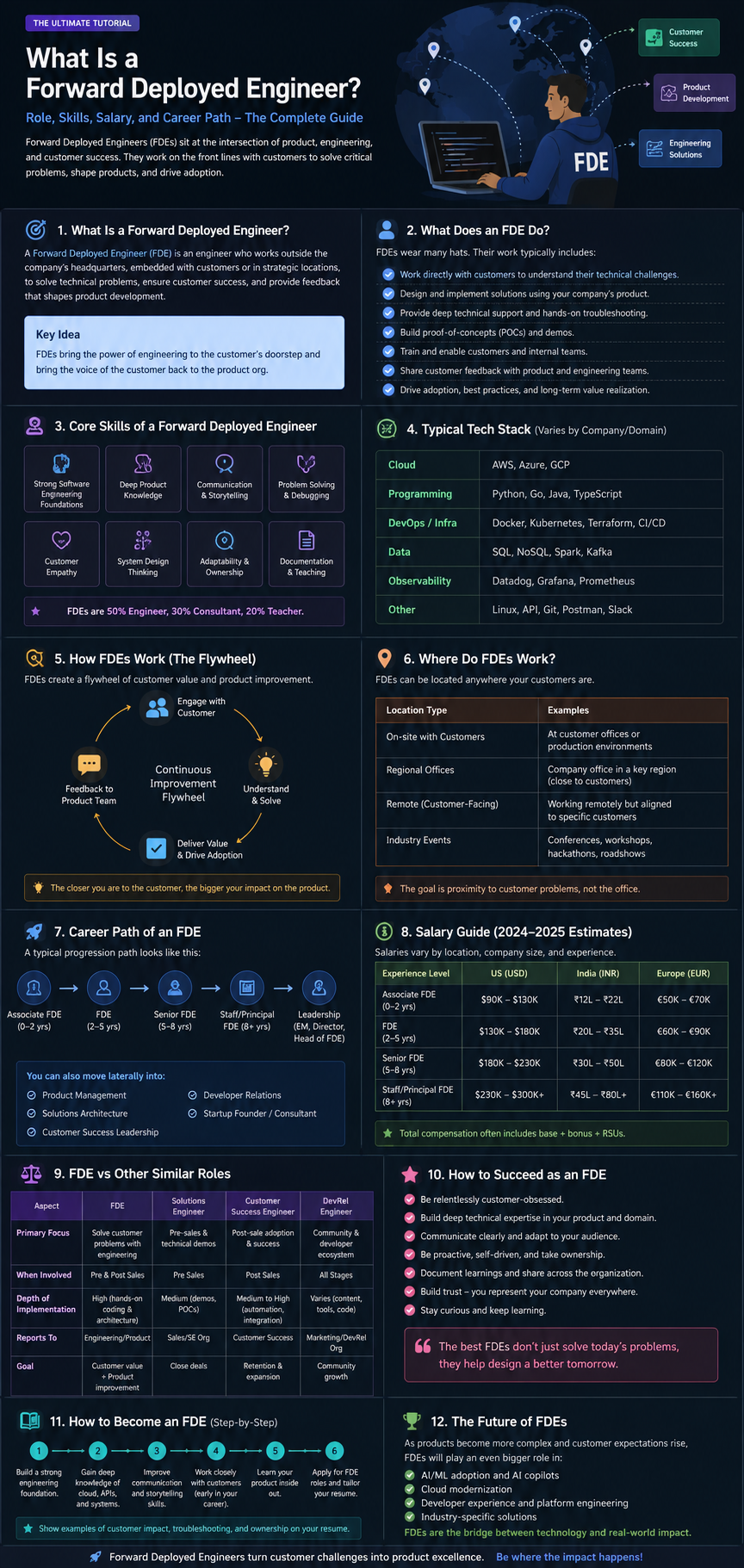
A Forward Deployed Engineer, often shortened as FDE, is an engineer who works very close to real customers, users, operations teams, and business problems. Instead of building software only from a company office and handing it over later, an FDE goes “forward” into the customer environment, understands the real problem deeply, writes production-grade code, integrates systems, deploys solutions, collects feedback, and helps convert software from an idea into working business value.
In simple words:
A Forward Deployed Engineer is a software engineer who goes where the problem is, builds where the users are, and turns complex technology into a working solution in the real world.
The role was strongly popularized by Palantir, where Forward Deployed Software Engineers work directly with customers, build custom applications, handle large-scale data, use AI, engage stakeholders from technical teams to executives, and own projects from idea to deployment. Palantir’s own job description also lists coding skills in languages such as Python, Java, C++, TypeScript, and JavaScript, plus possible travel to client sites.
In 2026, the role has become even more important because of enterprise AI. Companies do not only want AI demos. They want AI systems connected to real data, real workflows, real permissions, real compliance, real users, and measurable outcomes. This is exactly the gap FDEs are built to close.
AWS announced a dedicated Forward Deployed Engineering organization backed by a $1 billion investment to embed engineers directly with customers and co-develop agentic AI systems. AWS described the shift as moving from advisory roadmaps to production systems running under real customer constraints. Microsoft also announced Microsoft Frontier Company with a $2.5 billion investment, embedding 6,000 industry and engineering experts with customers to co-design, deploy, and improve AI systems at scale.
So, the FDE role is no longer a niche job title. It is becoming one of the most important hybrid engineering roles in the AI economy.
2. What Does “Forward Deployed” Mean?
The phrase forward deployed originally sounds like military or field operations language. It means sending a skilled team close to the actual mission area rather than keeping them far away from the action.
In the software world, it means:
| Word | Simple Meaning |
|---|---|
| Forward | Close to the customer, business process, field team, factory, bank, hospital, government unit, or operations environment |
| Deployed | Embedded, assigned, placed, or actively involved in the real implementation |
| Engineer | Someone who can design, code, integrate, debug, automate, deploy, and improve systems |
A Forward Deployed Engineer is not just “support.” Not just “sales.” Not just “consulting.” Not just “coding.” The role sits at the intersection of software engineering, product thinking, customer success, architecture, data, AI, security, and business problem-solving.
3. The Simplest Definition of a Forward Deployed Engineer
A Forward Deployed Engineer is a customer-facing software engineer who builds, customizes, integrates, and deploys technical solutions directly in the customer’s real environment.
A normal software engineer may ask:
“What feature should I build?”
An FDE asks:
“What real-world problem must be solved, which systems are involved, what data exists, who uses the workflow, what is blocking adoption, and what code must I write to make this work in production?”
That difference is the soul of the role.
4. Why the FDE Role Exists
Many companies buy powerful platforms but fail to get full value from them. The problem is usually not that the software is weak. The problem is that enterprise environments are messy.
Real companies have:
| Real-World Complexity | Why It Matters |
|---|---|
| Legacy systems | Old applications may not have modern APIs |
| Scattered data | Data may live across warehouses, SaaS tools, spreadsheets, logs, and custom databases |
| Security rules | Access control, audit logs, and compliance cannot be ignored |
| Domain-specific workflows | A hospital, bank, telecom, airline, and manufacturer all work differently |
| Internal politics | Business, IT, security, legal, and finance may all have different priorities |
| Unclear requirements | Users often cannot explain the exact system they need until they see it |
| AI uncertainty | LLMs behave differently depending on data, prompts, tools, permissions, and user behavior |
Traditional software delivery often fails because product teams are far from the field. Consulting teams may understand the customer but may not write production-grade product code. Support teams handle issues but may not own architecture. Sales teams promise outcomes but do not build them.
The FDE fills this gap.
5. FDE in One Diagram
flowchart LR
    A[Customer Problem] --> B[FDE Discovery]
    B --> C[Workflow Mapping]
    C --> D[Data and System Integration]
    D --> E[Prototype]
    E --> F[Production-Grade Build]
    F --> G[Deployment]
    G --> H[User Adoption]
    H --> I[Feedback to Product and Research]
    I --> F
This diagram shows why FDEs are so valuable. They do not stop at requirement gathering. They stay involved until the solution works in the real world.
6. FDE in the AI Era
Before AI became mainstream, FDEs mostly worked on data platforms, custom workflows, analytics, integrations, operational dashboards, enterprise software, and mission-critical systems.
In the AI era, FDEs are increasingly responsible for:
| AI-Era Responsibility | Example |
|---|---|
| LLM workflow design | Turning customer support tickets into automated triage workflows |
| Agentic AI deployment | Building agents that use tools, APIs, documents, and approval steps |
| RAG implementation | Connecting AI to company documents, databases, and knowledge bases |
| Evaluation systems | Measuring AI output quality, safety, accuracy, latency, and cost |
| Human-in-the-loop design | Deciding when AI acts alone and when humans approve |
| AI governance | Logging, access control, compliance, model monitoring, and auditability |
| Prompt and tool optimization | Improving prompts, functions, tools, retrieval, and workflows |
| Product feedback loop | Telling research and product teams where models fail in real usage |
OpenAI’s Tokyo Forward Deployed Engineer role, for example, asks for customer-facing engineering or technical deployment experience, production-grade frontend/backend coding, experience with LLM or generative model systems, clear communication, and the ability to make decisions under ambiguity.
That tells us something important: modern FDEs are not only implementation engineers. They are becoming AI product deployment engineers.
7. What Does a Forward Deployed Engineer Actually Do?
A good FDE may perform many jobs in a single week. The role can feel like software engineer + architect + product manager + consultant + SRE + technical founder.
7.1 Customer Discovery
The FDE starts by understanding the customer’s problem.
They ask:
| Question | Why It Matters |
|---|---|
| What is the painful business process? | Avoids building useless features |
| Who uses the workflow daily? | Identifies real users |
| What systems are involved? | Finds integration needs |
| What data is available? | Determines what can be automated |
| What are the security limits? | Prevents compliance failures |
| What is the measurable outcome? | Defines success clearly |
A weak FDE listens only to what the customer says.
A strong FDE discovers what the customer actually needs.
7.2 Technical Architecture
After discovery, the FDE designs the technical solution.
This may include:
| Area | Example |
|---|---|
| Backend architecture | APIs, workers, queues, microservices |
| Frontend | Internal dashboards, workflow tools, approval screens |
| Data | Pipelines, transformations, warehouse queries |
| AI | RAG, agents, prompts, model evaluation |
| Cloud | AWS, Azure, GCP, Kubernetes, serverless |
| Security | IAM, RBAC, audit logs, encryption |
| Observability | Logs, metrics, traces, dashboards |
| Reliability | Retries, rate limits, fallbacks, monitoring |
Stripe’s Forward Deployed Engineering backend role asks for experience with backend systems, scalable and secure systems, distributed systems, API design, data modeling, communication with technical and non-technical users, and direct user engagement.
7.3 Building Production-Grade Code
This is the biggest difference between an FDE and a traditional consultant.
An FDE does not only create slides.
They build.
They may write:
| Code Type | Example |
|---|---|
| API integration | Connect Salesforce, SAP, Stripe, ServiceNow, Snowflake |
| Data pipeline | Sync customer data into a platform |
| UI component | Build a custom workflow screen |
| Automation | Trigger actions based on events |
| AI agent | Let an LLM call approved tools safely |
| Test suite | Validate behavior before release |
| Infrastructure code | Terraform, Kubernetes YAML, CI/CD pipelines |
| Observability rules | Alerts, dashboards, traces, logs |
7.4 Deployment and Adoption
A normal engineering team may stop after shipping code. An FDE goes further.
They ask:
| Adoption Question | Reason |
|---|---|
| Are users actually using the system? | Usage matters more than demo success |
| Is the workflow faster now? | Measures business impact |
| Are users bypassing the system? | Reveals friction |
| Are there errors or edge cases? | Improves reliability |
| Can customer teams maintain it? | Reduces dependency |
| Should this become a core product feature? | Feeds product roadmap |
Stripe’s Privy FDE role describes end-to-end development, direct customer work, deployment, troubleshooting, customer feedback, and understanding customer codebases.
8. FDE vs Similar Roles
The FDE role can be confusing because it overlaps with many roles. Here is the cleanest comparison.
| Role | Main Focus | Writes Production Code? | Customer-Facing? | Owns Outcome? |
|---|---|---|---|---|
| Software Engineer | Build product features | Yes | Usually no | Partially |
| Product Engineer | Build user-facing product quickly | Yes | Sometimes | Yes |
| Solutions Engineer | Explain and design solution for customer | Sometimes | Yes | Partially |
| Sales Engineer | Support technical sales | Rarely | Yes | Sales outcome |
| Implementation Engineer | Configure and integrate product | Sometimes | Yes | Deployment outcome |
| Consultant | Advise, design, manage transformation | Sometimes | Yes | Business outcome |
| SRE | Reliability, uptime, operations | Yes | Internal or external | Reliability outcome |
| FDE | Build and deploy real solutions inside customer context | Yes | Strongly yes | Strongly yes |
FDE vs Software Engineer
A software engineer usually builds reusable product features for many customers.
An FDE builds or adapts solutions for a specific customer or mission, then feeds learnings back into the product.
FDE vs Solutions Engineer
A solutions engineer usually supports pre-sales, architecture, demos, and technical validation.
An FDE usually goes deeper into implementation and writes more production code.
FDE vs Consultant
A consultant may create strategy, roadmap, process design, and recommendations.
An FDE is expected to build working systems, not only advise.
FDE vs SRE
An SRE focuses on reliability, incident response, observability, automation, and production operations.
An FDE may use SRE skills but focuses more broadly on customer outcomes, product deployment, and business workflows.
9. The FDE Engagement Lifecycle
A professional FDE follows a repeatable lifecycle. This is where the role becomes advanced.
flowchart TD
    A[1. Mission Discovery] --> B[2. Current-State Mapping]
    B --> C[3. Success Metric Definition]
    C --> D[4. Solution Architecture]
    D --> E[5. Prototype or Proof of Value]
    E --> F[6. Production Build]
    F --> G[7. Deployment and Integration]
    G --> H[8. User Training and Adoption]
    H --> I[9. Measurement and Iteration]
    I --> J[10. Product Feedback]
    J --> D
Stage 1: Mission Discovery
The FDE understands the customer’s mission. For example:
| Industry | Mission Example |
|---|---|
| Banking | Reduce fraud investigation time |
| Healthcare | Improve patient intake workflow |
| Telecom | Predict network outages |
| Logistics | Optimize delivery route exceptions |
| Manufacturing | Detect quality issues earlier |
| Government | Improve emergency response coordination |
| SaaS | Improve enterprise onboarding |
Stage 2: Current-State Mapping
The FDE maps how work happens today.
This includes:
| Area | Example |
|---|---|
| People | Who performs the task? |
| Process | What steps are followed? |
| Data | Where does information come from? |
| Systems | Which tools are used? |
| Pain points | What is slow, manual, risky, or expensive? |
| Constraints | What cannot be changed? |
Stage 3: Success Metric Definition
A serious FDE never works with vague goals like “improve efficiency.”
They define measurable outcomes:
| Bad Goal | Better Goal |
|---|---|
| Improve support | Reduce average ticket triage time from 20 minutes to 5 minutes |
| Use AI | Automate 40% of low-risk document classification with human approval |
| Improve reporting | Cut manual weekly reporting from 8 hours to 30 minutes |
| Improve operations | Detect 90% of priority incidents within 2 minutes |
| Better onboarding | Reduce enterprise integration setup from 4 weeks to 5 days |
Stage 4: Solution Architecture
The FDE designs the first version of the system.
Stage 5: Prototype or Proof of Value
The FDE builds something quickly to prove value. The goal is not perfection. The goal is learning.
Stage 6: Production Build
The prototype becomes reliable, secure, tested, observable, and maintainable.
Stage 7: Deployment and Integration
The system is connected to real users, real systems, real data, and real workflows.
Stage 8: User Training and Adoption
The FDE helps users trust and use the system.
Stage 9: Measurement and Iteration
The FDE measures outcomes and improves the solution.
Stage 10: Product Feedback
The FDE sends field learnings back to product, engineering, and research teams. OpenAI explicitly includes sharing field feedback with product and research teams as part of its FDE role.
10. Core Skills Required for a Forward Deployed Engineer
A great FDE needs a rare skill combination.
10.1 Software Engineering Skills
Minimum technical skills usually include:
| Skill | Why It Matters |
|---|---|
| Python | APIs, automation, AI workflows, data pipelines |
| JavaScript/TypeScript | Frontend, full-stack apps, internal tools |
| SQL | Data investigation, analytics, integration |
| APIs | Most enterprise systems communicate through APIs |
| Data structures and algorithms | Needed for strong engineering fundamentals |
| Git | Collaboration and version control |
| Testing | Prevents fragile customer deployments |
| CI/CD | Speeds up safe delivery |
| Cloud | Most customer systems run on AWS, Azure, or GCP |
| Security | Enterprise deployments need permissions, audit, and compliance |
Palantir lists programming proficiency in languages such as Python, Java, C++, TypeScript, and JavaScript for FDSE roles. Stripe’s integration role also expects code-level debugging, SQL, data structures, algorithms, API architecture understanding, and security awareness.
10.2 Architecture Skills
An FDE must design systems that work inside messy environments.
Important architecture topics:
| Area | What to Learn |
|---|---|
| Distributed systems | Queues, retries, consistency, scaling |
| API design | REST, GraphQL, webhooks, idempotency |
| Data modeling | Entities, relationships, event models |
| Integration patterns | ETL, ELT, CDC, event-driven architecture |
| Identity and access | SSO, OAuth, RBAC, IAM |
| Observability | Logs, metrics, traces, alerts |
| Reliability | Timeouts, retries, fallback, circuit breakers |
| Security | Encryption, audit, secrets, least privilege |
10.3 AI and LLM Skills
For modern FDE roles, AI knowledge is becoming a major advantage.
| AI Skill | Practical Meaning |
|---|---|
| Prompt engineering | Write instructions that produce useful outputs |
| RAG | Connect LLMs to private company knowledge |
| Embeddings | Search documents semantically |
| Tool calling | Let AI call APIs safely |
| Agents | Build workflows where AI takes multi-step actions |
| Evaluation | Test quality, safety, accuracy, cost, and latency |
| Guardrails | Prevent unsafe or unauthorized behavior |
| Human review | Add approval steps for sensitive decisions |
| Model behavior | Understand hallucination, bias, drift, and limits |
OpenAI’s FDE requirements specifically mention experience building or deploying systems powered by LLMs or generative models and understanding how model behavior affects product experience. Stripe’s backend FDE role also lists interest or experience in AI-augmented engineering and LLM-powered tooling as preferred.
10.4 Business and Domain Skills
An FDE must understand the business domain enough to build the right thing.
Examples:
| Domain | Useful Knowledge |
|---|---|
| Finance | Payments, billing, reconciliation, risk |
| Healthcare | Patient workflows, privacy, clinical data |
| Telecom | Network operations, incidents, service quality |
| Manufacturing | Supply chain, quality, operations |
| Government | Security, mission workflows, compliance |
| Retail | Inventory, personalization, customer support |
10.5 Communication Skills
This role is impossible without communication.
An FDE must explain technical topics to non-technical people and business topics to engineers.
They must be able to:
| Skill | Example |
|---|---|
| Ask sharp questions | “What decision does this dashboard help you make?” |
| Simplify complexity | Explain AI limitations without jargon |
| Write clearly | Produce implementation plans, runbooks, and design docs |
| Manage ambiguity | Move forward even when requirements are unclear |
| Handle pressure | Work with executives, users, and engineers at once |
| Build trust | Users must believe the FDE understands their reality |
Stripe repeatedly highlights communication with technical and non-technical stakeholders, direct user engagement, and the ability to map business requirements to reliable technical solutions.
11. Tools and Technologies an FDE Should Know
There is no single fixed tool stack. But a strong FDE is usually comfortable across many layers.
| Category | Common Tools |
|---|---|
| Programming | Python, TypeScript, Java, Go, JavaScript |
| Frontend | React, Next.js, internal UI frameworks |
| Backend | FastAPI, Node.js, Spring Boot, Flask, Django |
| Databases | PostgreSQL, MySQL, MongoDB, Redis |
| Data | SQL, Spark, dbt, Airflow, Kafka |
| Cloud | AWS, Azure, GCP |
| Infrastructure | Docker, Kubernetes, Terraform |
| CI/CD | GitHub Actions, GitLab CI, Jenkins |
| Observability | Datadog, Grafana, Prometheus, OpenTelemetry |
| AI | OpenAI API, Azure OpenAI, Anthropic, LangChain, LlamaIndex |
| Search/RAG | Elasticsearch, OpenSearch, Pinecone, Weaviate, pgvector |
| Security | IAM, OAuth, SSO, Vault, KMS |
| Collaboration | Jira, Linear, Notion, Confluence, Slack |
A beginner does not need to know everything. But an FDE must become a strong generalist.
12. What Makes a Great FDE Different from an Average FDE?
| Average FDE | Great FDE |
|---|---|
| Builds what customer asks | Finds what customer actually needs |
| Focuses on demo | Focuses on adoption |
| Writes quick scripts | Builds maintainable systems |
| Waits for clear requirements | Creates clarity from ambiguity |
| Blames customer data | Designs around messy data |
| Avoids business discussions | Understands business impact |
| Works alone | Brings product, engineering, and customer together |
| Solves one ticket | Changes the workflow |
| Leaves undocumented code | Leaves runbooks, dashboards, tests, and ownership |
| Measures output | Measures outcome |
The best FDEs behave almost like technical founders inside customer environments.
13. Example: FDE Solving a Real AI Problem
Imagine a large insurance company wants to use AI to process claims faster.
Problem
Claims analysts receive thousands of documents: accident reports, invoices, photos, medical notes, emails, and policy documents. The company wants AI to classify documents, summarize claims, detect missing information, and suggest next actions.
What a weak implementation does
A weak team builds a chatbot demo that answers questions from uploaded PDFs.
It looks impressive, but fails in production because:
| Failure | Reason |
|---|---|
| Wrong answers | AI cannot access complete policy data |
| Security issue | Everyone can see all documents |
| No audit | No record of why AI gave an answer |
| No workflow | Analysts still copy-paste manually |
| No evaluation | No one measures accuracy |
| No adoption | Users do not trust it |
What an FDE does
A strong FDE designs the real system:
flowchart LR
    A[Claims Documents] --> B[Ingestion Pipeline]
    B --> C[Classification Model]
    C --> D[Policy and Customer Data Retrieval]
    D --> E[LLM Summary and Recommendation]
    E --> F[Human Review Screen]
    F --> G[Claims System Update]
    G --> H[Audit Log and Metrics]
    H --> I[Feedback Loop]
    I --> E
The FDE thinks about:
| Area | Decision |
|---|---|
| Security | Only authorized analysts can view each claim |
| Accuracy | AI confidence score required |
| Human review | No payment decision without human approval |
| Audit | Every AI recommendation is logged |
| Integration | Output goes back into claims system |
| Measurement | Track time saved, error rate, adoption |
| Reliability | Retry failed document processing |
| Cost | Use smaller models for classification, larger models for complex reasoning |
| Feedback | Analysts can mark bad summaries |
This is the difference between an AI demo and an AI system.
14. Salary of a Forward Deployed Engineer in 2026
Salary varies heavily by company, country, seniority, domain, and whether compensation includes equity or bonus.
14.1 United States
Glassdoor listed the average U.S. Forward Deployed Engineer salary at about $155,915 per year, with a typical range around $124,607 to $198,167, based on salary submissions as of July 2026. Glassdoor also showed recent individual total pay submissions above $250K in cities such as New York, Seattle, and Washington, DC.
Levels.fyi listed median Forward Deployed Software Engineer compensation at about $201,250, though salary sites should always be treated as directional because samples and role definitions vary.
Palantir’s own Forward Deployed Software Engineer posting listed an estimated salary range of $135,000 to $200,000 per year, with total compensation potentially including restricted stock units, sign-on bonus, and other incentives.
Stripe’s Privy Forward Deployed Engineer role listed a U.S. base salary range of $156,800 to $235,200, with possible equity, bonus, and benefits.
14.2 Canada and Europe
Stripe’s backend Forward Deployed Engineering role in Toronto listed an annual salary range of CA$172,000 to CA$258,000. Stripe’s Forward Deployed Integration Engineer role in Dublin listed a primary-location salary range of €104,000 to €156,000.
14.3 Japan
Glassdoor’s Tokyo data for Forward Deployed Engineer showed an average around ¥19,500,000 per year, with a reported range around ¥18,000,000 to ¥21,000,000; this should be treated carefully because location-specific salary datasets can have smaller sample sizes.
14.4 India
Glassdoor’s New Delhi data showed an average around ₹1,375,000 per year, with a typical range around ₹1,050,000 to ₹1,670,000; again, this is directional and may not represent top AI labs, global product companies, or remote international roles.
14.5 Salary Summary Table
| Region | Directional 2026 Range | Notes |
|---|---|---|
| United States | ~$125K–$235K+ base/total depending source | Top AI/product companies may include equity |
| Canada | CA$172K–CA$258K in one Stripe posting | Role and location specific |
| Ireland | €104K–€156K in one Stripe posting | Role and location specific |
| Tokyo, Japan | Around ¥18M–¥21M in Glassdoor FDE data | Likely small sample; use with caution |
| New Delhi, India | Around ₹1.05M–₹1.67M in Glassdoor data | May not reflect global remote/high-end roles |
Salary sites are useful, but the best way to judge compensation is to compare live job postings, company compensation bands, equity, bonus, travel expectations, location, and seniority.
15. Career Path of a Forward Deployed Engineer
The FDE career path is flexible. It can lead to engineering leadership, product leadership, solutions architecture, AI leadership, or startup founding.
flowchart TD
    A[Software Engineer / Data Engineer / DevOps / Consultant] --> B[Junior or Associate FDE]
    B --> C[Forward Deployed Engineer]
    C --> D[Senior FDE]
    D --> E[Lead FDE / Engagement Lead]
    E --> F[Forward Deployed Engineering Manager]
    E --> G[Product Manager / Product Lead]
    E --> H[Solutions Architect / Field CTO]
    E --> I[AI Transformation Lead]
    E --> J[Founder / Startup CTO]
15.1 Entry-Level Path
Some companies hire early-career FDEs if they have strong engineering fundamentals and communication skills. Palantir’s FDSE posting requires at least one year of relevant post-college experience.
15.2 Mid-Level Path
Most modern AI-era FDE roles prefer experienced engineers. OpenAI’s Tokyo FDE role asks for 5+ years of engineering or technical deployment experience including customer-facing work. Stripe’s backend FDE role also asks for 5+ years of software engineering experience.
15.3 Senior Path
Senior FDEs own larger customers, more complex systems, and higher-stakes outcomes. They often mentor other FDEs and influence product direction.
15.4 Leadership Path
FDE leaders manage teams, define methodology, shape customer strategy, and turn repeated field patterns into product strategy.
16. How to Become a Forward Deployed Engineer
Step 1: Become Strong in Software Engineering
Focus on:
| Topic | Target |
|---|---|
| One backend language | Python, Java, Go, or TypeScript |
| One frontend framework | React or Next.js |
| SQL | Joins, indexes, query optimization |
| APIs | REST, auth, pagination, error handling |
| Testing | Unit, integration, end-to-end |
| Git | Branching, pull requests, code review |
| System design | APIs, queues, caching, scaling |
Step 2: Learn Real Deployment
You must know how software reaches users.
Learn:
| Topic | Why |
|---|---|
| Docker | Package applications |
| Kubernetes | Run services at scale |
| CI/CD | Ship safely |
| Terraform | Manage infrastructure |
| Cloud basics | Deploy on AWS/Azure/GCP |
| Monitoring | Know when systems break |
| Logging | Debug production issues |
| Security basics | Avoid dangerous deployments |
Step 3: Build Customer-Facing Muscle
Practice explaining technical ideas simply.
You can build this through:
| Activity | Benefit |
|---|---|
| Freelance projects | Understand real client ambiguity |
| Internal platform projects | Learn stakeholder management |
| Open-source support | Learn user communication |
| Technical blogging | Improve explanation skills |
| Demos and workshops | Learn presentation |
| Consulting-style projects | Learn discovery and scoping |
Step 4: Learn AI Deployment
For 2026 and beyond, this is a major advantage.
Build projects involving:
| Project | What It Teaches |
|---|---|
| RAG chatbot over company docs | Retrieval, embeddings, security |
| AI support ticket triage | Classification, workflow automation |
| LLM evaluation dashboard | Quality measurement |
| Agent using APIs | Tool calling and permissions |
| Human approval workflow | Safe automation |
| Cost monitoring | Token cost, latency, model selection |
Step 5: Build a Portfolio That Looks Like FDE Work
A normal GitHub portfolio shows code.
An FDE portfolio should show business problem → architecture → implementation → deployment → measurement.
Your portfolio should include:
| Section | Example |
|---|---|
| Problem | “Manual invoice reconciliation takes 6 hours/day” |
| Users | Finance operations team |
| Architecture | Mermaid diagram |
| Tech stack | Python, PostgreSQL, React, Docker |
| Security | Role-based access |
| Deployment | AWS ECS or Kubernetes |
| Metrics | Reduced processing time by X% in simulation |
| Documentation | Setup guide, runbook, demo video |
17. Sample FDE Portfolio Project
Project Title
AI-Powered Incident Triage System for Cloud Operations
Problem
Cloud operations teams receive too many alerts. Engineers waste time reading logs, correlating incidents, and deciding priority.
Solution
Build an AI-assisted incident triage tool that collects alerts, logs, deployment events, and runbook documents, then suggests severity, likely cause, and next action.
Architecture
flowchart LR
    A[Prometheus Alerts] --> D[Incident Triage API]
    B[Application Logs] --> D
    C[Deployment Events] --> D
    E[Runbook Documents] --> F[Vector Database]
    F --> D
    D --> G[LLM Reasoning Layer]
    G --> H[Engineer Review UI]
    H --> I[Slack / Jira / PagerDuty]
    G --> J[Evaluation and Audit Log]
Tech Stack
| Layer | Tool |
|---|---|
| Backend | Python FastAPI |
| Frontend | React |
| Database | PostgreSQL |
| Vector Search | pgvector |
| AI | OpenAI or open-source LLM |
| Observability | Prometheus + Grafana |
| Deployment | Docker + Kubernetes |
| CI/CD | GitHub Actions |
Why This Is a Strong FDE Project
It shows:
| FDE Skill | Demonstrated By |
|---|---|
| Customer problem thinking | Alert fatigue |
| System design | Multiple inputs and outputs |
| AI deployment | LLM + retrieval |
| Security awareness | Audit logs |
| Human-in-the-loop | Engineer review |
| Integration | Slack/Jira/PagerDuty |
| Operations thinking | Observability and runbooks |
18. Interview Preparation for FDE Roles
FDE interviews often test more than coding.
18.1 Coding Interview
Expect:
| Area | Example |
|---|---|
| Algorithms | Arrays, maps, graphs, recursion |
| Backend coding | Build an API |
| Debugging | Fix broken code |
| Data handling | Parse and transform data |
| SQL | Write queries |
| Integration | Consume an external API |
18.2 System Design Interview
Possible questions:
| Question | What They Test |
|---|---|
| Design a customer support AI assistant | AI workflow, RAG, safety |
| Design an enterprise data integration platform | APIs, pipelines, auth |
| Design a fraud detection dashboard | Data modeling, UI, latency |
| Design a workflow automation system | Queues, permissions, events |
| Design a multi-tenant SaaS integration | Security, isolation, scalability |
18.3 Customer Simulation Interview
This is common for FDE-style roles.
They may ask:
“A customer says your platform is not giving value. What do you do?”
A strong answer:
- Understand the customer’s business goal.
- Identify current workflow and users.
- Check data quality, integrations, permissions, and adoption.
- Define measurable success.
- Build or adjust the solution.
- Deploy with a small user group.
- Measure impact.
- Create a repeatable path to scale.
18.4 Product Sense Interview
They may ask:
“Should this customer-specific feature become part of the core product?”
A strong FDE thinks about:
| Question | Why |
|---|---|
| Is this problem common across customers? | Product opportunity |
| Is the implementation reusable? | Engineering leverage |
| Is it too custom? | Maintenance risk |
| Does it improve product strategy? | Long-term value |
| Can it be generalized? | Platform thinking |
18.5 Behavioral Interview
Expect questions about:
| Topic | Example |
|---|---|
| Ambiguity | “Tell me about a time requirements were unclear.” |
| Conflict | “How did you handle a difficult stakeholder?” |
| Ownership | “When did you take responsibility beyond your role?” |
| Travel/field work | “Are you comfortable working directly with customers?” |
| Pressure | “How do you respond when a production deployment fails?” |
| Communication | “Explain a complex system to a non-technical executive.” |
19. FDE Resume Keywords
Use these keywords only if they are true for your experience.
| Category | Keywords |
|---|---|
| Role | Forward deployed engineering, customer-facing engineering, field engineering |
| Engineering | Python, TypeScript, Java, Go, APIs, distributed systems |
| Cloud | AWS, Azure, GCP, Kubernetes, Terraform |
| Data | SQL, data pipelines, ETL, analytics, data modeling |
| AI | LLM, RAG, agents, prompt engineering, evaluation, embeddings |
| Product | user workflows, product feedback, roadmap input |
| Customer | stakeholder management, discovery, implementation, adoption |
| Security | RBAC, IAM, OAuth, audit logs, compliance |
| Delivery | production deployment, CI/CD, observability, runbooks |
Example Resume Bullet
Instead of writing:
Worked with customers to build AI tools.
Write:
Designed and deployed an AI-assisted document review workflow for enterprise users, integrating private knowledge retrieval, role-based access, human approval, audit logging, and measurable adoption metrics.
20. Common Mistakes FDEs Must Avoid
Mistake 1: Becoming a Demo Engineer
A demo is not success. Adoption is success.
Mistake 2: Building Too Much Custom Code
Custom code can create long-term maintenance problems. A good FDE knows when to build, configure, generalize, or push something into the core product.
Mistake 3: Ignoring Security
Enterprise environments require permissions, audit logs, data boundaries, privacy rules, and compliance.
Mistake 4: Skipping Documentation
If the customer cannot operate the system after the FDE leaves, the project is fragile.
Mistake 5: Saying Yes to Everything
An FDE must be helpful but not reckless. Saying yes to every custom request creates technical debt.
Mistake 6: Not Measuring Outcome
Shipping code is not enough. The FDE must measure whether the workflow improved.
Mistake 7: Forgetting Product Feedback
The best FDEs turn field pain into product strategy.
21. Advanced FDE Concepts
21.1 Productization
Productization means turning repeated customer-specific solutions into reusable product features.
Example:
| Customer-Specific Build | Productized Feature |
|---|---|
| Custom Excel import for one bank | Generic configurable data import system |
| Custom AI approval workflow | Reusable human-in-the-loop module |
| One-off dashboard | Dashboard builder |
| Custom permissions script | Role-based access configuration |
| Manual onboarding checklist | Self-serve onboarding workflow |
A great FDE constantly asks:
“Is this a one-time solution, or is this a product pattern?”
21.2 Field Feedback Loop
flowchart LR
    A[Customer Pain] --> B[FDE Builds Solution]
    B --> C[Users Give Feedback]
    C --> D[FDE Identifies Pattern]
    D --> E[Product Team Improves Platform]
    E --> F[Next Customer Deploys Faster]
    F --> C
This is why FDEs are strategically valuable. They compress the distance between customer pain and product improvement.
21.3 AI Evaluation as an FDE Skill
In AI projects, “it works” is not enough.
An FDE must evaluate:
| Metric | Meaning |
|---|---|
| Accuracy | Is the answer correct? |
| Relevance | Does it answer the user’s actual question? |
| Groundedness | Is it based on approved data? |
| Hallucination rate | How often does it invent? |
| Latency | Is it fast enough? |
| Cost | Is token/model cost acceptable? |
| Safety | Does it avoid risky output? |
| Permission compliance | Does it respect user access? |
| Human override rate | How often do humans reject it? |
| Business outcome | Did the workflow improve? |
21.4 Governance
AI-era FDEs must care about governance.
A production AI system needs:
| Governance Control | Example |
|---|---|
| Access control | User can only query documents they are allowed to see |
| Audit logs | Record prompt, retrieved context, output, user action |
| Data retention policy | Do not store sensitive data forever |
| Model selection policy | Use approved models only |
| Human approval | Require review for high-risk actions |
| Evaluation reports | Track quality over time |
| Cost controls | Budget limits and model routing |
| Incident process | What happens if AI gives dangerous output? |
22. Is FDE a Good Career?
Yes, for the right person.
It is a strong career if you enjoy:
| You Enjoy | Why FDE Fits |
|---|---|
| Real-world problem solving | You work directly with actual user pain |
| Coding | You still build software |
| Business impact | Your work is tied to outcomes |
| Variety | Every customer and domain is different |
| Communication | You talk to users and executives |
| Ambiguity | You create clarity |
| AI deployment | You turn AI into production workflows |
It may not be ideal if you prefer:
| You Prefer | Why FDE May Be Hard |
|---|---|
| Deep isolated coding only | FDEs meet customers often |
| Stable requirements | Field work is ambiguous |
| No travel | Some roles require travel |
| Long product cycles | FDE work can be fast and urgent |
| Pure research | FDEs focus on deployment and outcomes |
| Avoiding business context | Business context is central |
23. Future of the FDE Role
The FDE role is likely to grow because enterprise AI adoption is hard. Companies are learning that AI value does not come only from buying models or tools. It comes from integrating AI into real work.
Business Insider reported that FDE job postings grew sharply from April 2025 to April 2026, linking the demand to enterprise AI deployment and companies such as OpenAI, Anthropic, Palantir, Stripe, and Google Cloud hiring for the role.
The next generation of FDEs may be called:
| Possible Future Title | Meaning |
|---|---|
| AI Forward Deployed Engineer | FDE focused on AI systems |
| Agentic AI Engineer | Engineer building AI agents in business workflows |
| Field AI Engineer | AI engineer embedded with customers |
| Customer Product Engineer | Product engineer working directly with customers |
| Enterprise AI Engineer | Engineer deploying AI in complex organizations |
| Applied AI Engineer | Engineer applying AI to real-world problems |
| AI Solutions Architect | More architecture-heavy version |
| Technical Deployment Engineer | More implementation-focused version |
The title may change. The core skill will remain valuable: turning advanced technology into working business outcomes.
24. The Gold Standard FDE Skill Matrix
Use this matrix to evaluate yourself.
| Level | Engineering | Customer Skill | Architecture | AI Skill | Product Thinking | Ownership |
|---|---|---|---|---|---|---|
| Beginner | Can code features | Can listen to users | Understands basic systems | Knows LLM basics | Understands requirements | Completes assigned tasks |
| Intermediate | Builds full-stack apps | Runs discovery calls | Designs APIs and data flows | Builds RAG/AI prototypes | Prioritizes user value | Owns small deployments |
| Advanced | Builds scalable systems | Manages stakeholders | Designs secure enterprise systems | Evaluates and governs AI | Converts patterns into product ideas | Owns customer outcomes |
| Expert | Sets technical direction | Trusted by executives | Designs reusable platforms | Builds production AI systems | Shapes roadmap | Leads mission-critical delivery |
25. 90-Day Learning Roadmap to Become an FDE
Days 1–30: Engineering Foundation
| Week | Focus |
|---|---|
| Week 1 | Python or TypeScript backend API |
| Week 2 | SQL, PostgreSQL, data modeling |
| Week 3 | React or basic frontend |
| Week 4 | Docker, GitHub Actions, deployment |
Days 31–60: Systems and Customer Context
| Week | Focus |
|---|---|
| Week 5 | API integrations and webhooks |
| Week 6 | Authentication, RBAC, OAuth basics |
| Week 7 | Observability: logs, metrics, alerts |
| Week 8 | Write design docs and runbooks |
Days 61–90: AI and FDE Portfolio
| Week | Focus |
|---|---|
| Week 9 | Build RAG over private documents |
| Week 10 | Add human approval and audit logging |
| Week 11 | Add evaluation and cost tracking |
| Week 12 | Publish case study, architecture, demo, and GitHub repo |
By the end of 90 days, you should have one serious project that looks like real FDE work.
26. FDE Interview Case Study Template
Use this structure when answering FDE case questions.
1. Clarify the Mission
“What business outcome are we trying to improve?”
2. Identify Users
“Who will use this daily?”
3. Map Current Workflow
“How does the process work today?”
4. Identify Systems and Data
“Which tools, APIs, databases, and documents are involved?”
5. Define Success Metrics
“What number proves this worked?”
6. Design Architecture
“Which components are required?”
7. Build Small First
“What is the fastest proof of value?”
8. Make It Production-Ready
“How do we secure, test, monitor, and scale it?”
9. Drive Adoption
“How do we train users and collect feedback?”
10. Feed Product
“What should become reusable for future customers?”
This framework will make your interview answers sound structured, senior, and outcome-focused.
27. FAQ
What is a Forward Deployed Engineer?
A Forward Deployed Engineer is a customer-facing engineer who designs, builds, integrates, and deploys software solutions directly in real customer environments.
Is an FDE a real software engineer?
Yes. A serious FDE writes production code, designs systems, handles integrations, debugs issues, and deploys solutions. The role is more customer-facing than a traditional software engineering role.
Is FDE the same as a Solutions Engineer?
No. A Solutions Engineer often focuses on demos, architecture, pre-sales, and technical validation. An FDE usually goes deeper into implementation and production code.
Is FDE a consulting role?
It overlaps with consulting, but a strong FDE is more hands-on. Consultants may advise; FDEs build and deploy.
Do FDEs travel?
Often, yes. Some roles require customer-site travel. Palantir’s FDSE posting mentions travel up to 25% depending on client needs and preferences. Stripe’s backend FDE role mentions willingness to travel 20–30% to Stripe sites and user locations.
Is FDE good for AI careers?
Yes. In 2026, many FDE roles are becoming closely tied to AI deployment, LLM systems, agents, RAG, evaluation, and enterprise AI adoption.
Can a DevOps or SRE become an FDE?
Yes. DevOps and SRE professionals already understand production systems, cloud, reliability, automation, and observability. To become an FDE, they should strengthen product thinking, customer communication, and full-stack or AI integration skills.
Can a fresher become an FDE?
It is possible at companies that hire early-career FDEs, but many AI-era roles prefer experienced engineers. A fresher should build strong coding, deployment, communication, and project portfolio skills.
What is the most important FDE skill?
The most important skill is not one programming language. It is the ability to understand a messy real-world problem, design a practical technical solution, build it, deploy it, and make users successful.
28. Final Summary
A Forward Deployed Engineer is one of the most powerful hybrid roles in modern technology. It combines software engineering, customer discovery, product thinking, AI deployment, architecture, communication, and business ownership.
The role exists because enterprise software and AI do not create value automatically. Someone must connect technology to real workflows, real users, real data, real security, and real outcomes. That someone is increasingly the FDE.
The best FDEs are not just coders. They are not just consultants. They are not just solution architects. They are builders who operate close to the mission.
A great Forward Deployed Engineer can walk into a messy customer environment, understand the problem, design the system, write the code, deploy the solution, train the users, measure the outcome, and bring the learning back into the product.
That is why the role is becoming so important in the AI era.
In one sentence:
A Forward Deployed Engineer is the engineer who turns advanced technology into real-world impact.