Introduction
Modern enterprise IT infrastructure is growing far too fast for human teams to manage manually. Microservices architectures, multi-cloud deployments, serverless functions, and edge computing generate millions of telemetry signals—logs, metrics, traces, and events—every single minute. When an outage occurs, traditional operations teams often spend hours sifting through noisy alerts to find a single root cause. This is where AIOps (Artificial Intelligence for IT Operations) shifts the paradigm. AIOps combines machine learning, big data, continuous automation, and deep observability to give enterprise systems the ability to self-heal, auto-scale, and predict failures before they impact business services. At the center of this transformation sits the AIOps Engineer—a specialist who bridges the gap between infrastructure engineering, software development, data science, and operational reliability. Whether you are a System Administrator, DevOps Engineer, Site Reliability Engineer (SRE), Cloud Specialist, or an aspiring IT professional, mastering the key skills required for an AIOps Engineer is one of the smartest career decisions you can make today.
Why AIOps Engineers Are in High Demand
The transition from legacy data centers to complex multi-cloud ecosystems created a major operational challenge: data overload. Traditional monitoring tools tell you that something is broken, but they fail to explain why or how to prevent it across thousands of interdependent microservices.
Here is why enterprise demand for skilled AIOps Engineers has skyrocketed:
- Alert Fatigue Reduction: Enterprises receive thousands of redundant operational alerts daily. AIOps Engineers build intelligent noise-reduction models that correlate alerts into single actionable incidents.
- Proactive vs. Reactive Operations: Instead of responding after a service goes down, AIOps systems detect anomalous patterns early—predicting disk failures, memory leaks, or network bottlenecks before users notice.
- Faster Mean Time to Resolution (MTTR): By automating root cause analysis (RCA) and event correlation, AIOps cuts incident resolution time from hours down to seconds.
- Multi-Cloud Complexity: Organizations running workloads across AWS, Azure, Google Cloud, and on-premises hardware require unified, AI-driven visibility to maintain platform stability.
What Does an AIOps Engineer Do?
An AIOps Engineer is not simply a DevOps engineer who uses AI tools, nor are they purely a Data Scientist building algorithms. Instead, an AIOps Engineer designs, deploys, and maintains the data pipelines, machine learning models, and automated response frameworks that streamline IT operations.
Core Responsibilities of an AIOps Engineer:
- Telemetry Data Ingestion: Building high-throughput pipelines using tools like Kafka or Vector to ingest logs, metrics, and traces across hybrid environments.
- Machine Learning Model Implementation: Applying time-series forecasting, anomaly detection, clustering, and Natural Language Processing (NLP) to operational data.
- Alert Correlation & Noise Reduction: Grouping millions of raw events into structured, context-aware incidents.
- Automated Remediation: Writing self-healing automation routines (using Ansible, Python, or Kubernetes Operators) triggered by AI model outputs.
- Observability Platform Management: Configuring open-source standards like OpenTelemetry alongside enterprise platforms to establish unified full-stack observability.
- Cross-Team Collaboration: Working alongside SREs, developers, and ITSM teams to continuously train operational AI models on real incident history.
Essential Technical Skills Required for an AIOps Engineer
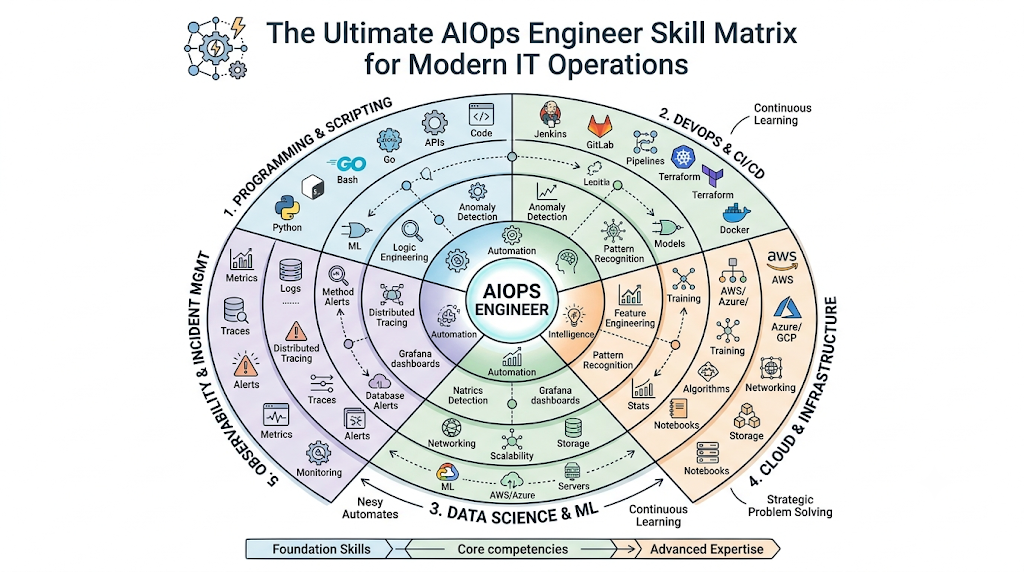
To excel in an AIOps role, you must build a strong foundation across multiple engineering disciplines. Let’s break down the core technical competencies step-by-step.
       +-------------------------------------------------------+
       |             Core AIOps Engineering Stack              |
       +-------------------------------------------------------+
       | 1. Programming (Python, Go, Bash)                     |
       | 2. Machine Learning & AI (Anomaly Detection, Time-Series)|
       | 3. Cloud & Infrastructure (AWS/Azure/GCP, IaC)        |
       | 4. Containers & Orchestration (Kubernetes, Docker)    |
       | 5. Observability & Telemetry (OpenTelemetry, Prometheus)|
       | 6. Automation & Self-Healing (Ansible, CI/CD, Event-Driven)|
       +-------------------------------------------------------+
Programming Languages Every AIOps Engineer Should Learn
Programming is the foundational foundation of AIOps engineering. You need languages that excel in data science, automation, and backend systems development.
- Python: The undisputed leader in AIOps. Python is required for writing machine learning algorithms, processing telemetry streams, interacting with cloud APIs, and building custom data parsing scripts using libraries like Pandas, NumPy, Scikit-learn, PyTorch, and TensorFlow.
- Go (Golang): Essential for working inside modern cloud-native ecosystems. Tools like Kubernetes, Docker, Prometheus, and OpenTelemetry are written in Go. Writing custom Kubernetes Operators, custom telemetry collectors, or high-performance CLI tools requires Go proficiency.
- Bash / Shell Scripting: Necessary for quick Linux system administration tasks, automated log manipulation, and container startup routine management.
Machine Learning and AI Knowledge
You do not need a Ph.D. in artificial intelligence, but you must understand how to apply machine learning algorithms to operational telemetry data.
- Time-Series Analysis: Understanding models like ARIMA, Prophet, and LSTM neural networks to forecast capacity needs, CPU spikes, and metric trends.
- Anomaly Detection: Implementing isolation forests, autoencoders, and statistical algorithms (Z-score, moving averages) to flag abnormal behavior without hardcoding static thresholds.
- Clustering & Correlation: Using DBSCAN, K-Means, or hierarchical clustering algorithms to group related alerts during a major outage.
- Natural Language Processing (NLP): Applying NLP and Large Language Models (LLMs) to analyze unstructured log messages, parse stack traces, and summarize incident incident reports.
- Generative AI & Agentic AI: Leveraging GenAI assistants and autonomous agents to automate initial incident triage and query complex log datasets naturally.
Cloud Computing Skills
Modern enterprise IT runs in the cloud. An AIOps Engineer must know how to deploy, monitor, and cost-optimize workloads across major platforms.
- AWS, Azure, and Google Cloud Platform (GCP): Deep understanding of core services like compute instances, object storage, serverless functions, VPC networks, and IAM security controls.
- Native Cloud Observability Services: Hands-on experience with AWS CloudWatch, Azure Monitor, and Google Cloud Operations Suite.
- Multi-Cloud Architecture: Designing platform integrations that aggregate operational data across disparate cloud environments into a unified telemetry plane.
- FinOps & Capacity Planning: Using AI metrics to optimize cloud spending, right-size compute resources, and predict infrastructure capacity requirements.
DevOps and CI/CD Knowledge
AIOps enhances DevOps practices by introducing data-driven feedback loops directly into continuous integration and continuous deployment pipelines.
- Infrastructure as Code (IaC): Proficiency in Terraform, OpenTofu, and CloudFormation to provision environments, observability agents, and pipelines repeatably.
- CI/CD Pipeline Integration: Using GitHub Actions, GitLab CI, or Jenkins to test, train, and deploy operational AI models seamlessly alongside application code.
- GitOps Workflows: Utilizing ArgoCD or Flux to ensure system configurations and observability settings match version-controlled Git repositories.
- Canary & Blue-Green Deployments: Configuring AIOps metrics to evaluate canary releases automatically—rolling back deployments if AI models detect latency regressions.
Kubernetes and Docker Skills
Microservices hosted inside container runtime environments represent the primary operational ecosystem for modern enterprise software.
- Container Fundamentals: Building optimized Docker containers, understanding multi-stage builds, and managing container security images.
- Kubernetes Cluster Administration: Managing pods, deployments, services, ingress controllers, ConfigMaps, and persistent storage volumes.
- Cluster Observability: Ingesting metrics from Kube-State-Metrics, Node Exporter, and cAdvisor to evaluate cluster health.
- Custom Resource Definitions (CRDs) & Operators: Building custom controller logic that executes self-healing operations directly within Kubernetes based on AIOps triggers.
Monitoring and Observability Skills
Observability is the primary data engine that powers AIOps. You must know how to capture the “Three Pillars of Observability”—Logs, Metrics, and Traces—plus Events.
       +-------------------------------------------------------+
       |            The Telemetry Foundations                  |
       +-------------------------------------------------------+
       |  Metrics  -> Quantitative numeric trends over time    |
       |  Logs     -> Timestamped event records with context   |
       |  Traces   -> End-to-end request flows across services |
       |  Events   -> System state changes, deployments, alerts|
       +-------------------------------------------------------+
- OpenTelemetry (OTel): Mastering the industry-standard framework for collecting, processing, and exporting vendor-agnostic telemetry data.
- Metrics Collection: Deploying Prometheus, Thanos, or VictoriaMetrics to store and query high-cardinality operational metrics using PromQL.
- Log Aggregation & Search: Operating Elasticsearch, Fluentd, Fluent Bit, Loki, or Logstash to aggregate unstructured logs efficiently.
- Distributed Tracing: Implementing Jaeger, Zipkin, or OpenTelemetry instrumentation to trace request journeys through microservices architectures.
Automation Skills
AIOps is incomplete without automated action. Detecting an issue using AI provides value only when connected to automated remediation systems.
- Event-Driven Automation: Triggering automated runbooks (via tools like StackStorm, Ansible EDA, or AWS Lambda) directly from AIOps alert feeds.
- Configuration Management: Using Ansible, Puppet, or Chef to restore drift, apply patches, and update infrastructure state automatically.
- Self-Healing Workflows: Writing scripts that execute common operational recovery tasks—such as restarting dead services, clearing disk space, or scaling auto-scaling groups—without human intervention.
Linux and Networking Fundamentals
Behind every cloud server, container, and AI model sits a core operating system and network stack.
- Linux Administration: Deep familiarity with process management, systemd services, memory allocation, disk I/O analysis, and file permissions.
- Troubleshooting Commands: Mastery of CLI commands like
top,htop,vmstat,iostat,journalctl,netstat,tcpdump, andstrace. - Networking Concepts: Strong grasp of TCP/IP, DNS, HTTP/S protocols, load balancing, firewalls, routing tables, and service mesh networks (Istio, Linkerd).
Database Knowledge
AIOps Engineers deal with two separate database paradigms: operational databases that require monitoring, and time-series/data-lake stores that hold telemetry.
- Time-Series Databases (TSDB): Working with Prometheus TSDB, InfluxDB, and TimescaleDB designed for high-write telemetry throughput.
- Data Lakes & Search Engines: Administering Elasticsearch, OpenSearch, Apache Pinot, or Snowflake to store historical operational data for long-term pattern analysis.
- Relational & NoSQL Monitoring: Understanding how to monitor performance, lock contention, slow queries, and connection pools in PostgreSQL, MySQL, MongoDB, and Redis.
Security Awareness (DevSecOps & AI Security)
Security must be embedded into every step of the AIOps pipeline.
- Data Privacy & Anonymization: Ensuring sensitive information (PII, tokens, secrets) is scrubbed or masked from log streams before sending data to AI models.
- AI Model Security: Protecting operational AI pipelines against data poisoning, model evasion, and unauthorized access.
- Identity and Access Management (IAM): Implementing least-privilege policies across automation systems, API tokens, and cloud infrastructure.
Essential Soft Skills Required for an AIOps Engineer
Technical knowledge gets you in the door, but soft skills determine how effective you will be at transforming enterprise operations.
Incident Management Skills
When major systems go down, AIOps Engineers must remain calm under high-pressure conditions. You need a structured approach to triage, communication, and post-incident reviews (post-mortems) that focus on learning rather than assigning blame.
Collaboration and Communication Skills
AIOps Engineers sit at the intersection of Developers, SREs, Security specialists, and Business Executives. You must translate complex machine learning metrics and system health indicators into clear business impacts that non-technical stakeholders can easily understand.
Problem-Solving and Analytical Thinking
Systems behave in unexpected ways when scaled across distributed networks. An effective AIOps Engineer approaches failures like a investigator—hypothesizing causes, analyzing telemetry data logically, and verifying solutions thoroughly before automating them.
Popular Tools Used by AIOps Engineers
To thrive in the field, you should gain hands-on experience with both open-source frameworks and enterprise AIOps platforms.
| Tool Name | Category | Primary Use Case | Key Strengths |
| Dynatrace | Enterprise AIOps | Full-stack observability & root-cause engine | Automated causal AI (Davis engine), auto-discovery |
| Datadog | SaaS Observability | Infrastructure, log, & application monitoring | Broad integrations, intuitive UI, Watchdog AI |
| Splunk Enterprise | Log & IT Analytics | Machine data ingestion & event correlation | Powerful SPL search query language, security integration |
| Elastic (ELK Stack) | Search & Observability | Log management, metrics, & trace analytics | Open ecosystem, high-speed search capabilities |
| Prometheus | Open-Source Metrics | Kubernetes and time-series metric monitoring | Industry standard for cloud-native metrics and alerting |
| OpenTelemetry | Open Standard | Telemetry collection, processing, & routing | Vendor-neutral, open-source instrumentation framework |
| BigPanda | Event Correlation | Autonomous incident intelligence & alert noise reduction | Cross-domain alert correlation, ITSM integration |
| PagerDuty | Incident Response | Automated incident routing & runbook trigger | Event intelligence, on-call orchestration, AIOps workflows |
| Moogsoft | AIOps & Alerting | Noise reduction and incident context building | Real-time algorithmic noise reduction |
Certifications That Can Help You Become an AIOps Engineer
Certifications demonstrate validated expertise to prospective employers. While dedicated AIOps certifications are evolving rapidly, combining cloud, DevOps, Kubernetes, and AI certifications builds an impressive profile:
- Certified Kubernetes Administrator (CKA): Proves deep hands-on expertise in orchestrating container workloads.
- AWS Certified DevOps Engineer – Professional / Azure DevOps Engineer Expert: Validates cloud infrastructure automation and deployment pipeline mastery.
- Datadog / Dynatrace / Splunk Professional Certifications: Demonstrates proficiency in top enterprise observability platforms.
- AWS Certified Machine Learning – Specialty / Azure AI Engineer Associate: Builds credibility in applying machine learning workflows.
- AIOps Specialist Training & Certifications (AIOpsSchool.com): Comprehensive, industry-aligned training programs specifically designed to master end-to-end AIOps engineering practices.
Step-by-Step Learning Roadmap
If you are starting from scratch or transitioning from a traditional IT role, follow this structured roadmap:
Step 1: Linux, Networking & Programming (Python/Go)
   │
   ▼
Step 2: Containers & Kubernetes (Docker, Orchestration)
   │
   ▼
Step 3: Cloud Platforms & DevOps (AWS/Azure, Infrastructure as Code)
   │
   ▼
Step 4: Observability & Telemetry (OpenTelemetry, Prometheus, ELK)
   │
   ▼
Step 5: Applied AI & Machine Learning (Time-Series, Anomaly Detection)
   │
   ▼
Step 6: Event Automation & Self-Healing Workflows
Step 1: Master Linux, Networking, and Python
Build a firm command of the Linux command line, networking protocols (TCP/IP, DNS), and core Python programming. Practice writing scripts to parse log files and interact with web APIs.
Step 2: Learn Containers and Kubernetes
Learn how to containerize applications with Docker. Transition into Kubernetes to master pod deployment, ingress routing, service management, and logging agents.
Step 3: Gain Cloud & DevOps Proficiency
Pick one primary cloud vendor (AWS, Azure, or GCP). Practice provisioning resources using Terraform and automating code deployments with GitHub Actions or GitLab CI.
Step 4: Implement Full-Stack Observability
Set up Prometheus, Grafana, and OpenTelemetry in a Kubernetes cluster. Capture metrics, logs, and distributed traces from a sample microservices application.
Step 5: Study Machine Learning Fundamentals
Learn how to apply Python libraries (Scikit-learn, Pandas) to telemetry data. Practice building time-series forecasting models and statistical anomaly detectors on system metrics.
Step 6: Connect Telemetry to Event-Driven Automation
Build end-to-end automated remediation pipelines. Trigger an automated recovery script (using Python, AWS Lambda, or Ansible) whenever your anomaly detector flags a simulated system failure.
Common Mistakes Beginners Should Avoid
- Ignoring Fundamentals for Shiny Tools: Trying to learn complex AIOps software without a strong understanding of Linux, networking, and basic cloud architecture.
- Treating AI as a Magic Solution: Expecting machine learning models to solve operational chaos without clean telemetry data input. Remember: garbage in, garbage out.
- Overlooking Soft Skills: Focusing solely on code while ignoring the team communication and incident response workflows required during actual system outages.
- Skipping Hands-On Practice: Relying only on video tutorials without building real microservices environments to monitor, break, and fix.
- Neglecting Open Standards: Learning only proprietary vendor interfaces while skipping open standards like OpenTelemetry and Prometheus.
Career Opportunities and Salary Insights
The job market for AIOps specialists is expanding quickly as enterprises seek to optimize their IT operations expenses and improve uptime.
Job Titles in the AIOps Domain:
- AIOps Engineer / Architect
- Site Reliability Engineer (SRE) with AIOps Specialization
- DevOps & Observability Engineer
- AI Operations Specialist
- Platform Automation Engineer
Salary Trends Overview (2026 Data):
- United States / North America:
- Entry to Mid-Level (1–4 years): $110,000 – $145,000 per year.
- Senior Level (5+ years): $160,000 – $220,000+ per year.
- India:
- Entry Level (0–2 years): ₹6,000,000 – ₹1,200,000 PA.
- Mid-Level (3–6 years): ₹1,500,000 – ₹2,800,000 PA.
- Senior AIOps Specialist / Architect (7+ years): ₹3,500,000 – ₹5,000,000+ PA.
- Europe:
- Mid-Level: €65,000 – €85,000 per year.
- Senior Level: €90,000 – €130,000+ per year.
Future Trends in AIOps
As IT ecosystems evolve, several key trends are shaping the future of AIOps engineering:
- Generative AI for Incident Triage: Large Language Models are being integrated directly into observability platforms to generate instant, human-readable root cause summaries and suggest precise code fixes during outages.
- Autonomous Agentic IT Operations: Autonomous AI agents capable of executing multi-step diagnostic investigations and performing complex remediation tasks without manual intervention.
- Shift to OpenTelemetry Standardization: OpenTelemetry is becoming the universal telemetry collection standard across all cloud architectures, reducing vendor lock-in risk.
- FinOps and Green IT Optimization: AIOps algorithms are being increasingly used to reduce cloud carbon footprints and optimize infrastructure costs dynamically.
- Observability as Code (OaC): Managing dashboards, alert rules, and telemetry pipelines entirely through version-controlled configuration files alongside software source code.
Frequently Asked Questions
Can a beginner start a career directly as an AIOps Engineer?
Yes, beginners can start a career in AIOps, but it requires dedication to learning foundational skills first. Starting with Linux, basic Python programming, cloud concepts, and container fundamentals provides the necessary base before transitioning into machine learning and telemetry analytics.
Is coding mandatory for an AIOps Engineer?
Yes, coding is essential. While you do not need to build complex enterprise applications, you must write Python scripts, work with shell commands, manipulate JSON/YAML data structures, write automation runbooks, and interact with cloud REST APIs.
How is AIOps different from traditional DevOps?
DevOps focuses on cultural alignment, continuous integration, continuous delivery, and infrastructure automation. AIOps enhances DevOps by applying machine learning and big data analytics to operational telemetry, enabling automated predictive analysis, alert correlation, and self-healing systems.
Do I need a degree in Data Science to work in AIOps?
No, a formal degree in Data Science is not required. Employers value practical engineering skills in cloud computing, observability tools, Kubernetes, and applied machine learning models over formal theoretical degrees.
Which programming language is best for AIOps?
Python is the best overall language for AIOps due to its extensive ecosystem of machine learning libraries (Scikit-learn, PyTorch, Pandas) and cloud automation SDKs. Go (Golang) is an excellent secondary language for cloud-native infrastructure work.
What is the difference between Observability and AIOps?
Observability focuses on capturing telemetry data (logs, metrics, traces) to allow humans to understand the internal state of a system. AIOps takes that telemetry data and uses machine learning to analyze patterns, reduce alert noise, pinpoint root causes, and execute automated remediations automatically.
Is AIOps going to replace DevOps Engineers?
No, AIOps will not replace DevOps Engineers. Instead, it elevates their role by automating tedious, repetitive tasks like manual log digging and alert sorting—allowing DevOps and SRE teams to focus on system architecture, security, and feature delivery.
What are the top tools an AIOps Engineer must know?
An AIOps Engineer should be familiar with open-source tools like Prometheus, OpenTelemetry, Grafana, and Elastic, along with commercial enterprise platforms like Dynatrace, Datadog, Splunk, and BigPanda.
How long does it take to learn AIOps engineering skills?
If you already have a background in Linux, DevOps, or System Administration, you can build core AIOps skills in 4 to 6 months of dedicated learning. For complete beginners, it typically takes 8 to 12 months of structured training and hands-on practice.
What is the career growth prospect for an AIOps Specialist?
The career trajectory for AIOps specialists is strong. With enterprise IT environments growing in complexity every year, professionals with expertise in AI-driven automation, observability, and cloud operations will remain among the most sought-after technical specialists in the industry.
Conclusion
The modern IT landscape has permanently shifted. As microservices and multi-cloud architectures continue to scale, relying on manual monitoring and reactive incident management is no longer viable. The future of IT operations belongs to intelligent, data-driven, self-healing systems—and the skilled engineers who build them. By mastering the key skills required for an AIOps Engineer—from Python programming and cloud orchestration to OpenTelemetry, machine learning, and automated remediation—you position yourself at the forefront of one of the fastest-growing and highest-paying career paths in technology today.